by Jim Lane (Biofuels Digest) The U.S. currently recovers significant biogas, generating enough renewable electricity for 2.4 million homes. While landfills produce the majority, agricultural and food waste digesters are rapidly expanding. Co-digesting manure with food waste or perennial grasses significantly













E15 and the Farm Bill: A Gettysburg and Vicksburg Story
by Jim Lane (Biofuels Digest) ... Because this week on Capitol Hill, rural energy advocates found themselves fighting on two fronts at once: the loud, highly visible struggle over year-round E15, and the slower, grinding campaign to move a long-stalled Farm Bill through Congress after years of delay, stalemate, and political trench warfare. One fight was about holding the line. The other was about controlling the river.
And like most Washington campaigns, neither side consists of cartoon villains twirling mustaches beneath the Capitol dome. Oil-state lawmakers, representing refiners already squeezed by compliance costs and narrowing margins, were never likely to stand quietly by while E15 advanced toward year-round permanence. One suspects many of them felt rather like Pickett’s men stepping out from the tree line at Gettysburg: perhaps doubtful of success, but not especially free to decline the assignment.
Meanwhile, supporters of the Farm Bill have spent the better part of four years in something resembling Grant’s Vicksburg campaign — repeated failures, procedural dead ends, changing strategies, uneasy coalitions, and the persistent belief that somehow, eventually, the river had to be opened.
Now, at last, both battles appear to be reaching decisive phases at the same moment.
The House narrowly passed the “Farm, Food, and National Security Act of 2026” by a 224-200 vote, the farthest a Farm Bill has advanced since the 2018 legislation. Yet even that fragile victory nearly collapsed amid a fierce internal fight over year-round E15 authorization. For rural energy advocates, the stakes extend far beyond ethanol blends alone.
The Farm Bill’s Energy and Rural Development titles quietly shape much of the physical architecture of the American bioeconomy. Sustainable aviation fuel (SAF) enters more firmly into the definition of advanced biofuels, while the bill directs the Secretary of Agriculture to establish a department-wide SAF strategy. Biorefinery assistance programs receive renewed backing. The Rural Energy for America Program (REAP) expands into waste-energy recovery. Federal biobased procurement standards move toward modernization, while national labeling terminology for plant-based and biobased products edges closer to uniformity.
None of these provisions arrive with the dramatic flourish of a floor fight over summer gasoline blends. But then Vicksburg never possessed the romance of Gettysburg either, despite controlling the Mississippi and ultimately splitting the Confederacy in two. The E15 battle, by contrast, has all the noise and smoke one expects from close-range political combat.
Beneath the rhetoric lies the long-running problem refiners call the “blend wall.” Americans consume less gasoline per capita than they once did, while federal Renewable Fuel Standard quotas continue pushing larger volumes of ethanol into the fuel pool. To comply, refiners either blend more biofuels or purchase compliance credits, costs critics estimate now approach $20 billion annually across the system. Large integrated refiners can often absorb the burden more easily. Smaller operators, especially in parts of the Midwest and Rust Belt, argue the mandates hit them with the force of artillery fire directed at already thin margins.
Most gasoline sold in the United States already contains roughly 10 percent ethanol. E15 raises the blend to 15 percent, and supporters have long sought year-round authorization rather than seasonal waivers and regulatory uncertainty. Refiners and oil-state lawmakers counter that compliance burdens, infrastructure constraints, and fuel-market distortions continue to impose heavy costs, especially on smaller operators already working with thin margins.
...
Refiners see compliance burdens. Corn growers see market survival. Environmental groups see emissions tradeoffs. Lawmakers see regional economies and voting blocs. Editorial writers see market distortions and political horse-trading. But pull back far enough and the fight begins to look less like a dispute over fuel chemistry than a larger struggle over resilience, supply chains, strategic flexibility, and who absorbs the costs of transition.
Some of those costs appear in refinery balance sheets and farm ledgers. Others arrive more quietly, a few cents at a time at the fuel pump or another season of uncertainty for growers trying to decide what to plant into unstable export markets.
There is, underneath the E15 debate, a curious “gasoline is” problem. Americans still talk about gasoline as though it were a singular and settled thing, the way people once said “the United States are.” But modern gasoline is already a negotiated blend of molecules, oxygenates, octane strategies, refinery economics, seasonal formulations, geopolitical assumptions, and regulatory compromises.
Pull back even farther and the argument stops being about one fuel versus another entirely. It becomes an argument about what kind of energy system the country believes it is actually operating.
That question has only grown sharper in recent weeks. The Strait of Hormuz crisis has quietly altered the geometry of the discussion. Not long ago, much of the American energy conversation rested on assumptions of durable abundance and permanently cheap domestic supply. But chokepoints have a way of reminding markets that volume and resilience are not the same thing. Logistics still matter. Shipping lanes still matter. Flexibility still matters.
Congress, much like Civil War generals, often discovers that the map and the terrain are two different things entirely. That reality shaped this week’s procedural warfare in the House. Republican leadership initially attempted to attach year-round E15 authorization directly to the Farm Bill, only to trigger an immediate rebellion from oil-state lawmakers. Leadership ultimately struck a compromise: decouple the measures, hold a separate standalone E15 vote on May 13, and in the meantime effectively lash the wagons together by delaying transmission of the Farm Bill to the Senate until the E15 vote occurs.
Classic Washington horse-trading, certainly. But also evidence of something deeper: a recognition that these fights, once treated as separate regional disputes, increasingly belong to the same interconnected system. READ MORE
Related articles
- Stop the myths — allow year-round E15 (Renewable Fuels Association/The Hill)
- House expected to vote on nationwide E15 sales bill this week (Brownfield Ag News)
- Congress nears key vote on permanent year-round E15 access (Brownfield Ag News)
- Ag Policy Blog: CEOs Heading to China With Trump; E15 Bill on Deck in House (DTN Progressive Farmer)
-
Discussion Document – Effect of Ethanol Blending on Gasoline RVP (National Renewable Energy Laboratory)
Excerpt from Renewable Fuels Association/The Hill: The House will soon vote on a bill allowing nationwide, year-round sales of E15, a lower-cost gasoline blend containing 15 percent American-made ethanol. The bill also makes targeted reforms (supported by 80 percent of the oil industry) to the Renewable Fuel Standard to ensure refiners are able to compete on a level playing field when it comes to renewable fuel blending obligations.
Unfortunately, ahead of this crucial vote, anti-ethanol rhetoric and misinformation have reached a fever pitch. And it’s all coming from a small group of mid-sized oil refiners who have exploited loopholes in the existing RFS program to avoid blending biofuels. In recent days, certain members of Congress and front groups for those Fortune 500 refiners have ramped up their inflammatory and erroneous attacks on E15, ethanol and America’s farmers. It’s time to set the record straight.
When you pull into any retail gas station offering E15 today, your own eyes will see that the fuel is the lowest-cost option available. E15 typically sells for 15 to 40 cents per gallon less than standard E10 gasoline; often, the savings are even greater.
The average E15 price (as reported by real people at real gas stations) in recent weeks has been 42 cents per gallon less than E10 prices at those same stations. That’s a savings of over 10 percent. And when compared to prices for E0 or ethanol-free gasoline, E15 is typically priced at a discount of $1 per gallon or more.
E15 opponents expect you to somehow believe that voluntary E15 expansion mysteriously translates to higher pump prices. It’s common sense: Ethanol costs less than gasoline — a lot less — at wholesale terminals where fuels are blended. Adding more low-cost ethanol will result in a lower price for the finished fuel. In fact, a fuel blender in the Chicago market could buy a gallon of ethanol that comes with a Renewable Fuel Standard compliance credit for just $2 last week, compared to $3.60 per gallon for gasoline blendstock.
Some have demanded reforms to the RFS in exchange for giving consumers across the country the choice to purchase E15 year-round. That’s why the measure being voted on this week includes modifications to small refinery exemptions under the RFS. These sensible changes modify the requirements for which entities qualify for an exemption, ensuring that mid-sized refiners can’t continue to exploit a loophole that has undermined the RFS for years.
These carefully tailored provisions are a key reason that members on both sides of the aisle, farm organizations, fuel retailers, consumer advocates, and an overwhelming swath of the petroleum industry have lined up to support this critical legislation.
However, when the economic and policy arguments are debunked, opponents turn to the other well-worn myths. These arguments don’t hold up against the science.
Anti-ethanol groups allege that E15 is a raw deal for vehicle fuel economy. But actual testing of 20 late-model vehicles by the University of California, Riverside, shows that the difference in miles per gallon is negligible. On average, the vehicles tested saw a 1 percent fuel economy reduction when using E15 instead of E10. That means a car getting 29 miles per gallon on E10 would be expected to get 28.7 miles per gallon on E15. And when E15 is priced 8 to 10 percent lower than E10 at the pump, drivers choosing E15 enjoy a much lower cost per mile traveled than drivers choosing E10 — and that’s what really matters.
Given all the recent attention to E15, one would be forgiven for thinking that it is somehow a new fuel. In fact, the Environmental Protection Agency approved E15 as a legal fuel in 2011 and it is available at nearly 5,000 locations across 36 states. E15 is legally approved for use in 95 percent of the vehicles on the road today. The main barrier to growth has been the arbitrary federal restriction, which prevents E15 from being sold during the summer months, that Congress is voting to remove this week.
Congress should not let the opposition by a handful of Fortune 500 refining companies stand in the way of lower prices at the pump — especially now as gas prices soar. Congress has the opportunity to deliver real savings for American families by passing the bipartisan Nationwide Consumer and Fuel Retailer Choice Act, and finally giving drivers the ability to use lower-cost E15 all year long. READ MORE
Excerpt from DTN Progressive Farmer: E15 VOTE EXPECTED IN HOUSE
House Majority Leader Steve Scalise, R-La., has listed the bill to legalize the sale of E15 fuel nationwide and year round for a vote this week (week of May 11, 2026).
Scalise did not announce a day for the vote, but there have been reports it will be Wednesday.
The bill, H.R. 1346, is titled the "Nationwide Consumer and Fuel Retailer Choice Act of 2025." It is sponsored by Rep. Adrian Smith, R-Neb.
Smith and Reps. Michelle Fischbach, R-Minn., and Nikki Budzinski, D-Ill., and National Corn Growers Association President Jed Bower, an Ohio farmer, have scheduled a news conference today (May 12, 2026) to promote the bill.
Representatives from the American Farm Bureau Federation, Growth Energy, the National Farmers Union, and the Renewable Fuels Association will also be available to answer reporters' questions.
The National Farmers Union sent its members an action alert on Monday telling them to urge Congress to vote for the bill.
Still, the bill is drawing pushback from high places. The Wall Street Journal's editorial on Monday suggested farm-state lawmakers and ethanol supporters, "threatened to hold the farm bill hostage" over E15. The WSJ suggested higher ethanol blends "can increase smog in warm weather, which is why EPA restricts its sale during the summer." The editorial also suggested higher ethanol blends "can corrode gasoline pumps, storage tanks and other infrastructure unless retailers and distributors make upgrades." The editorial stated the legislation would hurt small refiners as well.
"There may be a compromise in permitting year-round E15 in areas with low smog, in return for repealing the ethanol mandate. But the ethanol lobby wants to have it every which way, and it's taking advantage of election-year politics and sympathy in Congress for soybean and corn farmers hurt by tariffs," the WSJ wrote.
House leadership promised Midwestern Republicans a vote on E15 in order to get their votes for passage of the farm bill. Small and medium-sized refiners have objected to the content of H.R. 1346 and there have been rumors of changes to the bill.
House Democrats have called for a vote on E15 but a House Democratic aide said whether Democrats vote for it "really depends on the bill itself" and that there were "rumors over the weekend that the majority was watering it down to further appease refiners." READ MORE
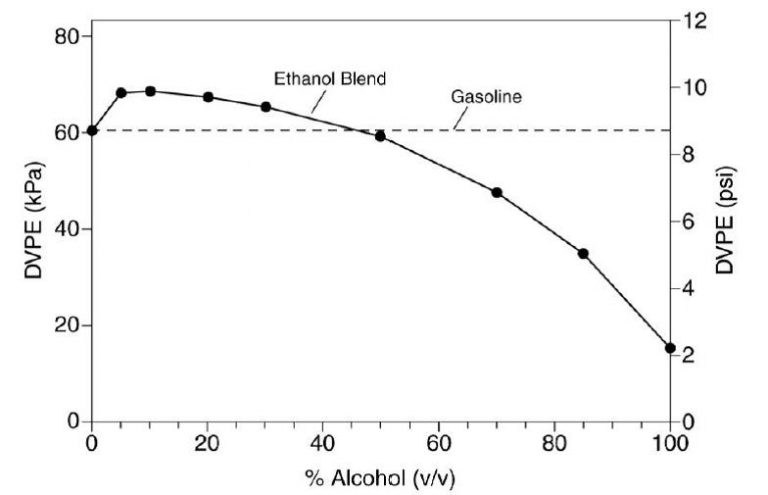
Excerpt from National Renewable Energy Laboratory: Blending of ethanol into gasoline at 10 volume percent causes the RVP to increase by about 1 psi despite the fact that fuel grade ethanol has a lower vapor pressure than gasoline (see Figure 1).
The low vapor pressure of fuel grade ethanol is caused by attractive forces between the ethanol molecules. The strongly electronegative oxygen atom in each ethanol molecule is attracted to the somewhat positive hydrogen atoms in other ethanol molecules.
The attraction between ethanol molecules means that it has a stronger tendency to stay as a liquid and not vaporize into the more dispersed gaseous state. However, when blended into gasoline at relatively low concentrations the more numerous gasoline molecules disrupt the attractive forces between ethanol molecules and allow the ethanol to readily evaporate, raising the vapor pressure of the blend. Not surprisingly this increase in vapor pressure with ethanol is more marked with the lower RVP hydrocarbon blendstocks. This would be true with the addition of any component which raises vapor pressure, as the final pressure is a weighted average of the pressure contributions of all of the components.
As ethanol content is increased above about 20% the vapor pressure increase becomes less, and above about 50% ethanol vapor pressure for the blend is less than that of the gasoline.
Figure 1. Effect of ethanol blending on vapor pressure of gasoline.
When ethanol was first permitted as an additive in gasoline at concentrations of up to 10% in 1979, its effect on vapor pressure was not regulated.3 In 1992, new EPA regulations (40 CFR 80.27) provided a 1-psi waiver for ethanol blends that contained between 9 and 10 percent ethanol.
Most, but not all, of the state-set RVP standards also allow a 1-psi waiver for blends of 9 to 10 percent ethanol.4,5 The purpose of the 1-psi waiver was to support the emerging ethanol industry. At that time EPA believed it would be difficult to economically justify a separate storage and distribution system for the small amount of lower vapor pressure gasoline needed for ethanol blending, with the result that low RVP gasoline blendstock for ethanol blending would not be made available. 6
The waiver allowed E10 to be made with the same gasoline distributed as finished fuel to be used without ethanol addition. Allowing vapor pressure to increase also lets refiners keep volatile components in the gasoline. READ MORE
QUOTE OF THE WEEK -- Angie Craig
I do not believe that we will see a vote on E15 come to this House floor, that standing down on E15 was walking away from our family farmers. -- House Agriculture Committee Ranking Member Angie Craig (D-MN 2nd) READ MORE Related articles
From Feasible to Fragile: Why Bioeconomy Projects Stall When Models Meet Reality
by M. Uzair Shah and Nourredine Abdoulmoumine (University of Tennessee, Knoxville/Biofuels Digest) The hidden gap between modeled feasibility and real-world deployment — and how integrated decision-making can close it What looked feasible in pieces becomes fragile as a whole. That is the single
May 12, 2026 Read Full Article
Aether Fuels and FlyORO Sign MOU to Explore Integrated SAF Supply-Chain and Blending Solutions for Project Beacon and Future Aether Projects
(FlyORO) The Singapore-rooted collaboration would connect Project Beacon’s first-of-a-kind next-generation SAF pathway with modular blending technology first launched in Singapore. KEY HIGHLIGHTS Non-binding MOU to jointly explore potential SAF supply-chain, blending and related activities in support of Project Beacon and future Aether SAF
May 12, 2026 Read Full Article
Rewriting the RFS Playbook: The Challenge of Meeting D4 Biomass-Based Diesel RIN Generation for 2026-2027
by Todd Hubbs and Scott Irwin (Oklahoma State University and University of Illinois/farmdoc daily) On March 27, 2026, the U.S. Environmental Protection Agency (EPA) released the final “Set 2” rule establishing Renewable Volume Obligations (RVOs) under the Renewable Fuel Standard (RFS)
May 12, 2026 Read Full Article
E15 and the Farm Bill: A Gettysburg and Vicksburg Story
by Jim Lane (Biofuels Digest) ... Because this week on Capitol Hill, rural energy advocates found themselves fighting on two fronts at once: the loud, highly visible struggle over year-round E15, and the slower, grinding campaign to move a long-stalled
May 12, 2026 Read Full Article
How Maize Has Emerged as India’s Leading Ethanol Feedstock?
by Richa Sharma (Business Today/MSN) India’s ethanol blending programme continues to demonstrate strong momentum, with cumulative ethanol supplies touching approximately 515 crore litres during the first six months of Ethanol Supply Year (ESY) 2025-26, according to industry estimates and supply trends
May 12, 2026 Read Full Article
Future of Biogas Europe 2026 --- November 25-26, 2026 --- Amsterdam, Netherlands

The Future of Biogas Europe Summit will return to Amsterdam, The Netherlands, on 25th and 26th November 2026, bringing together senior decision-makers and key stakeholders from across the biogas and renewable gas value chain. As momentum behind Europe’s energy transition
May 12, 2026 Read Full Article
Shanghai Climate Week Champions Innovative Applications of Ethanol
(U.S. Grains and BioProducts Council) dLast week, U.S. Grains & BioProducts Council (USGBC) staff from its office in Beijing, China attended events during Shanghai Climate Week to explore collaborative opportunities between U.S. ethanol exporters and Chinese end-users and consumers. Last week,
May 12, 2026 Read Full Article
Commission Publishes Simplification Review of EU Deforestation Regulation m Public Comment DEADLINE June 1, 2026
(European Commission) Today (May 3, 2026), the Commission published a report on the simplification of the revised EU Deforestation Regulation (EUDR) and a set of further measures for a smooth and effective implementation following the agreement of co-legislators last December. These
May 12, 2026 Read Full Article
Council Staff, Members Promote Ethanol at Singapore Energy Conferences
(U.S. Grains and Bioproducts Council) The U.S. Grains & BioProducts Council (USGBC) recently participated in a pair of ethanol conferences in Singapore highlighting the fuel’s applications in aviation, maritime and on-road transportation. USGBC Deputy Regional Director for Southeast Asia & Oceania
May 12, 2026 Read Full Article
Issue 193: Singapore-Listed Palm Oil Stocks Catch Biodiesel Spark
by Kenneth Lim (Business Times) This week in ESG: Analysts raise forecasts for crude palm oil as Iran war continues -- Shares of Singapore-listed palm oil companies have climbed steadily so far this year as the war in Iran further elevates the
May 12, 2026 Read Full Article
New Lancaster County Biodiesel Hub Aims to Expand Cleaner-Burning Fuel Access
by Lori Burkholder (WGAL) Construction is happening right now in Lancaster County on a new hub to distribute biodiesel, with the owners, Rhoads Energy, saying it will expand access to cleaner-burning fuel in the region. The site in Rapho Township just broke
May 12, 2026 Read Full Article
Jet Fuel Volatility Is a Warning and Sugarcane Biofuels Are the Response
Thomas Funke (South Africa Cane Growers/IOL) South Africa’s aviation sector is experiencing another cost crisis as a result of the fact that the country does not control the fundamentals of its own jet fuel supply. This reflects a domestic gap - the
May 11, 2026 Read Full Article
Unither Makes Aviation History with First Piloted Hydrogen-Powered Helicopter Flight
(Fuel Cells Works) • Unither Bioelectronics completes the world’s first piloted hydrogen-electric helicopter flight using a modified Robinson R44 in Canada. The milestone flight used a hydrogen fuel cell and electric motor system, proving viability for zero-emission vertical-lift missions, including future organ
May 11, 2026 Read Full Article
US Exported One-Fifth of RD and SAF in Second Half of 2025
(Biofuels International) The United States exported around 20% of its renewable diesel and sustainable aviation fuel (SAF) during the second half of last year, reflecting both rising domestic production and growing international demand for low‑carbon fuels. This shift highlights the country’s expanding
May 11, 2026 Read Full Article
UT Startup to Scale Hydrogen Fuel Cell Tech with UT Seed Fund Investment
(UT News) Celadyne, a startup launched out of UT Austin, is utilizing dual-use materials to solve long-standing infrastructure challenges in hydrogen production and storage, clearing a path for hydrogen’s widespread adoption. -- Discovery to Impact, the group overseeing the UT Seed
May 11, 2026 Read Full Article
DP World Helps Displace 24% of Port Diesel with Lower Carbon Fuel at Prince Rupert
(DP World Globe Newswire) More than 2 million litres of conventional diesel displaced as port partners target 2.7 million litres in 2026 -- DP World and its partners displaced nearly 24% of conventional diesel use at the Port of Prince Rupert in
May 11, 2026 Read Full Article
Jakarta to Build New Waste-to-Energy Plants, Enforce Waste Segregation
by Endang Mulyani (Jakarta Globe) Jakarta is stepping up efforts to tackle its mounting waste problem by accelerating the development of waste-to-energy plants while enforcing stricter household waste segregation policies. Governor Pramono Anung said the city is moving forward with plans to build
May 11, 2026 Read Full Article
The Digest’s 2026 Multi-Slide Guide to Decentralized Biomanufacturing Platforms
by Jim Lane (Biofuels Digest) Visolis is pioneering the decentralized production of chemicals and fuels using its proprietary mevalonolactone (MEV) platform, which upgrades biomass into high-value products. In a highly newsworthy development for national security, Visolis recently secured $2.86 million from
May 11, 2026 Read Full Article
Ontario Funds Biofuel Testing Facility at Thunder Bay Pulp and Paper
by Peter Saunders (Pulp and Paper Canada) The government of Ontario has earmarked $5.5 million to help Greenwater Technology produce renewable diesel and sustainable aviation fuel using byproducts and underused wood at Thunder Bay Pulp and Paper. The cleantech company’s $15.5 million
May 10, 2026 Read Full Article
Argus Road Fuels Europe Conference --- November 17-19, 2026 --- Munich, Germany
Navigating volatility in Europe’s road fuels markets: supply, demand and global trade flows -- Join Europe’s leading road fuels event to understand the forces reshaping gasoline, diesel and alternative fuel markets across the region. The Argus Road Fuels Europe conference returns at
May 08, 2026 Read Full Article
Paraguay Regulates the Ethanol Law to Boost the Domestic Market
(Paraguay Ministry of Industry and Trade/Bnamericas) The president of the Republic, Santiago Peña, signed the regulatory decree of the Ethanol Law, which regulates Laws No. 7357/2024 and No. 7391/2024, with a focus on strengthening domestic production and directly benefiting sugarcane growers, guaranteeing
May 08, 2026 Read Full Article
Developing Biowaste Coatings to Boost CO2-to-Fuel Conversion
(National University of Singpore) ... One of the most promising routes for diversifying fuel production from crude oil is using renewable electricity for electrochemical conversion of carbon dioxide (CO2) into high-value products such as ethylene that today come almost exclusively
May 08, 2026 Read Full Article
Advanced Pre-Treatment Plant Successfully Commissioned in Ghent: BDI and Ghent Renewables Achieve Milestone
(BDI) BDI-BioEnergy International and Ghent Renewables have successfully commissioned an industry-leading feedstock PreTreatment plant at North Sea Port in Ghent. The jointly realized facility marks a major milestone in advancing the processing of complex waste streams into high-quality raw feedstock for
May 08, 2026 Read Full Article
Grupo HAM Will Have BioGNL and/or BioCNG Available throughout Its Network of Spanish Service Stations during the Month of May
(HAM Group) The company is completing the rollout announced at the end of 2025 and reinforcing its commitment to biomethane as a renewable solution for professional transport HAM Group announces that, during the month of May, its entire network of refuelling stations
May 08, 2026 Read Full Article
Syntholene Publishes Independent Validation of Step-Change Cost Reduction for Synthetic Jet Fuel
(Syntholene/Newsfile Corp) Fuel Expert Robert Rapier Validates Syntholene's Unique Pathway to Low-Cost Hydrogen and Synthetic Aviation Fuel -- Syntholene Energy Corp. (TSXV: ESAF) (FSE: 3DD0) (OTCQB: SYNTF) ("Syntholene" or the "Company") has published an independent technical and economic report (the "Report") that
May 08, 2026 Read Full Article
The Digest’s 2026 Multi-Slide Guide to the Bioindustrial Manufacturing Ecosystem
by Jim Lane (Biofuels Digest) BioMADE is tackling the critical shortage of U.S. pilot-scale biomanufacturing infrastructure to prevent domestic innovators from moving scale-up operations overseas. Supported by $208 million across 92 projects, the Department of Defense-backed institute is launching Phase I
May 08, 2026 Read Full Article
New $4M State Grant Jump-Starts Green Energy Project on Pennsylvania Dairy Farm
(Ag-Grid Energy) Walmoore Ag-Grid Will Generate Electricity from Cow Manure and Food Waste and Export 1 MW Base Load 24/7 to PA Grid -- Walmoore Ag-Grid, Ag-Grid Energy’s first dairy farm digester project in Pennsylvania, is now in active development thanks to
May 08, 2026 Read Full Article
Carbon Concepts
by Lisa Gibson (Ethanol Producer Magazine) Carbon is top of mind for ethanol producers, in light of moving markets and lucrative incentives to lower CI scores. While some producers have engaged in reuse contracts for decades, others are just starting their
May 08, 2026 Read Full Article
Hawaii Lawmakers Pass Bill to Create Clean Fuel Standard
by Erin Krueger (Ethanol Produce Magazine) Hawaii lawmakers on May 6 approved legislation to create a clean fuel standard (CFS) that aims to reduce the carbon intensity (CI) of transportation fuels by at lease 50% below 2019 levels by 2045. The
May 08, 2026 Read Full Article
The Parallax of Oil Prices
by Jim Lane (Biofuels Digest) ... Fuel remains mostly invisible until suddenly it isn’t. That is the strange thing about oil markets. They create what might be called a parallax of price. In astronomy, parallax describes how an object appears to shift
May 08, 2026 Read Full Article
SAVE THE DATE 2027 International Biomass Conference & Expo --- March 2-4, 2027 --- Atlanta, GA
SAVE THE DATE
May 07, 2026 Read Full Article
Europe’s Biofuel Crossroads
(Biofuels International) As Europe accelerates towards net-zero emissions and greater energy independence, the biofuel industry stands at a critical juncture. Once heralded as a cornerstone of decarbonising transport and delivering rural economic benefits, the sector in 2026 presents a complex picture: rapid
May 07, 2026 Read Full Article
CALL FOR ABSTRACTS Value of Biogas West --- October 6-8, 2026 --- Vancouver, British Columbia, Canada DEADLINE June 12, 2026

2026 Value of Biogas West returns to beautiful Vancouver this fall. The three-day event features a site tour on Tuesday October 6, one and a half days of conference programming on Wednesday and Thursday October 7 and 8, an expanded
May 07, 2026 Read Full Article
2026 ACT Expo Fleet Awards Honor Leaders in Clean Transportation Deployment
(ACT News) The ACT Expo Fleet Awards have long recognized fleets that are not only adopting cleaner transportation technologies, but also demonstrating how those technologies can be deployed at scale across real-world operations. The 2026 winners reflect that continued momentum, with
May 07, 2026 Read Full Article
FedEx Freight Incoming CEO: Sustainability Must Be Built on Business Reality
(ACT News) (CEO John Smith said sustainability has become a core requirement for LTL carriers, but it must make business sense to scale; FedEx Freight is leaning into CNG powered by renewable natural gas as a near-term solution while deploying electric
May 07, 2026 Read Full Article
Planes and Ships Could Run on Kelp Someday, but There Are Serious Hurdles
by Zoe Beketova and Ana Georgescu (MIT Graduate Program in Science Writing/Associated Press) Green cells whirl around a red-light chamber, propelled by a blade through bubbling water. These little seaweed cells, called gametophytes, will develop into a strain of fast-growing kelp
May 07, 2026 Read Full Article
Turning Plastic Waste into Clean Fuel Using Sunlight
(Adelaide University) Scientists are advancing a promising solution to two of the world’s biggest challenges – plastic pollution and clean energy – by transforming waste plastics into valuable fuels using sunlight. A new paper led by Adelaide University PhD candidate Xiao Lu
May 07, 2026 Read Full Article
X-Press Feeders Signs Bio-Methanol Offtake LOI
by Gary Howard (Seatrade Maritime News) Feeder operator to take up to 15,000 tonnes of bio-methanol from PuriFire Energy and explore potential new port-based bio-methanol production facilities. -- X-Press feeders announced the signing of a letter of intent (LOI) with UK-based clean
May 07, 2026 Read Full Article
Wärtsilä Joins EU-Funded Consortium to further Accelerate Zero-Carbon Shipping for Long-Distance Vessels
(Wärtsilä) Technology group Wärtsilä has joined H4PERION, an EU-funded Horizon Europe project led by the University of Vaasa in Finland, to help accelerate the transition to zero-carbon long-distance shipping. The four-year project will develop and demonstrate solutions to improve engine efficiency
May 07, 2026 Read Full Article
Growth Energy: E15 Could Save Consumers More than $150 Million This Summer
(Growth Energy) Growth Energy, the nation’s largest biofuel trade association, today (May 6, 2026) released new data showing that fuel retailers sold nearly 2.5 billion gallons of E15 in 2025, underscoring the growing demand for a lower-cost fuel option that could
May 07, 2026 Read Full Article
Why Biomethane Trading Just Quietly Entered a New Phase
by Leon Stille (OilPrice.com) Updated mass balance rules from International Sustainability and Carbon Certification are tightening how biomethane is traded; Biomethane is becoming central to Europe’s renewable fuels system; The impact is financial as much as regulatory—projects and trading structures must be robust and
May 07, 2026 Read Full Article
Lucia Cosulich Launching Ceremony
(Fratelli Cosulich) Just two months after the launch of the first vessel in this new series, Lucia Cosulich took to the water on 2 May 2026, marking another step forward in Fratelli Cosulich’s Marine Energy Unit commitment to alternative marine fuels
May 07, 2026 Read Full Article
IMO Climate Talks Stay Alive as Carbon Plan Survives U.S. Pushback at MEPC 84
by Mike Schuler (gCaptain) The International Maritime Organization has kept its landmark shipping climate framework alive following a week of high-stakes negotiations in London, setting up a decisive endgame later this year after deep divisions again blocked a final deal. The outcome
May 07, 2026 Read Full Article
FortisBC Hits 10,000 LNG Refuelling Events for Marine Vessels
(FortisBC) Delivering safe, reliable LNG bunkering to help marine operators access lower carbon intensity fuel -- FortisBC Energy Inc. (FortisBC) has reached a major milestone with the completion of its 10,000th liquefied natural gas (LNG) refuelling event for marine vessels, underscoring the
May 07, 2026 Read Full Article
Green Methanol Facility to Convert Invasive Kutch Weed into Marine Fuel
(Chemical Industry Digest) A plant long regarded as one of the world’s “top 100 invasive species” could soon power India’s green shipping ambitions. Prosopis juliflora, a hardy shrub that has choked biodiversity across Kutch’s Banni grasslands for decades, is set to
May 07, 2026 Read Full Article
Novonesis: Strong Demand from Biofuel Sector Contributes to Q1 Sales Growth
by Erin Krueger (Ethanol Producer Magazine) Denmark-based biosolutions company Novonesis on May 5 reported 7% organic sales growth for the first quarter. Sales growth was supported by increased demand from first- and second-generation ethanol producers. Sales to the biodiesel industry also
May 07, 2026 Read Full Article
Bayer and bp Form Strategic Alliance to Jointly Scale Camelina as Intermediate Crop for Biofuels
(Bayer) Collaboration to commercialize camelina for producing renewable diesel (RD) and sustainable aviation fuels (SAF); bp will bring expertise in fuel and refining, Bayer its expertise in seed technology and extensive farmer customer base; Camelina brings added value as intermediate crop, rotational
May 07, 2026 Read Full Article
USMCA Continuation Important to Farmers, Others
by Larry Lee (Brownfield Ag News) Maintaining the USMCA trade deal with minor adjustments was the common message from farmers, processors, and government officials in Green Bay on Wednesday. Brian Kuehl with Farmers for Free Trade tells Brownfield improved access for
May 07, 2026 Read Full Article
Ethanol Free: Anti-ethanol Rhetoric and Misinformation Have Reached a Fever Pitch
by Geoff Cooper (Renewable Fuels Association) ... Without a shred of credible evidence or analysis, the anti-E15 crowd suggests that simply allowing retail gas stations to voluntarily offer E15 would somehow lead to “higher gas prices” and restricting SREs to truly
May 07, 2026 Read Full Article
Biofuels Dance the Samba. The Italy-Brazil Partnership
by Rossana Miranda (Decode 39) Italy is looking to Brazil as a strategic partner to build new industrial and energy supply chains around biofuels, as the long-awaited EU-Mercosur agreement opens a new phase in economic relations between Europe and South America. That was
May 06, 2026 Read Full Article
PBF Reports Increased Renewable Diesel Production for Q1
by Erin Krueger (Biodiesel Magazine) PBF Energy Inc. on April 30 announced the St. Bernard Renewables facility produced approximately 16,700 barrels pe day of renewable diesel during the first quarter of 2026, up from 10,000 barrels per day during the same
May 06, 2026 Read Full Article
Valero Reports Improved Q1 Earnings for Ethanol, DGD Joint Venture
by Erin Krueger (Biodiesel Magazine) Valero Energy Corp. on April 30 released first quarter financial results, reporting a profitable three-month period for both its ethanol segment and Diamond Green Diesel joint venture, which produces renewable diesel and sustainable aviation fuel (SAF). ... During
May 06, 2026 Read Full Article
Neste Reports Strong Renewable Products Margins for Q1
by Erin Krueger (Biodiesel Magazine) Neste Corp.’s renewable products segment experienced a significant increase in earnings during the first quarter of 2026 despite lower production volumes, according to the company’s April 29 earnings release. The increase is attributed to stronger term
May 06, 2026 Read Full Article
Marathon Reports Improved Q1 for Renewable Diesel Segment
by Erin Krueger (Biomass Magazine) Marathon Petroleum Corp. released first quarter financial results on May 5, reporting a significant increase in adjusted EBITDA for its renewable diesel segment on stronger margins and the recognition of 45Z clean fuel production credits. Marathon currently
May 06, 2026 Read Full Article
Phillips 66: Renewable Fuel Segment Currently Producing at above Nameplate Capacity
by Erin Krueger (Biomass Magazine) Phillips 66 released first quarter financial results on April 29, reporting a decrease in pre-tax loss for its renewable fuels segment. As economics for biobased diesel fuels continue to improve, the company expects to see additional
May 06, 2026 Read Full Article
Renewable Natural Gas Breaking Motor Fuel Usage Records
by Dan Gage (The Transport Project) RNG Accounted for 94 Percent of On-Road NGV Fuel Use in 2025 -- The Transport Project (TTP) today (May 5, 2026) announced that 94 percent of all on-road fuel used in natural gas vehicles in calendar
May 06, 2026 Read Full Article
Stranded Molecules: Why US SAF Can't Cross the Atlantic to Fill Europe's Mandate Gap
(SAF Path) The trans-Atlantic SAF trade Europe was counting on isn't price-blocked, ship-blocked, or supply-blocked. It's certification-blocked. -- The trans-Atlantic SAF trade that policy modelers assumed would balance the system, US molecules flowing east into a structurally short EU market, is not
May 06, 2026 Read Full Article
Scaling Up Bio 2026: Sovereignty, Security, Jobs --- November 18-21, 2026 --- Ottawa, Ontario, Canada

The world is experiencing an industrial revolution powered by advances in biotechnology and biomanufacturing. These transformative technologies will produce low carbon, bio-based alternatives to petroleum-based products such as chemicals, fuels, and materials. Learn how low carbon bio-technologies are leading the
May 06, 2026 Read Full Article
The Scale-Up Journey of Biobased Processes: Real-World Challenges, Surprises and Success --- May 12, 2026 --- ONLINE

The bioeconomy is not built at laboratory scale. It is built in the difficult, expensive, unpredictable territory between promising results and industrial reality — where processes encounter feedstock variability, contamination risk, financing constraints, engineering surprises, and the hard physics of
May 06, 2026 Read Full Article
Biomass Conference Podcast Series
(BBI) Recorded Live at the 2026 Int'l Biomass Conference & Expo March 31 - April 2 in Nashville, TN Produced by Biomass Magazine, the Biomass Conference Podcast Series Features: Brunette Machinery Co., Inc., BE&E, WastAway, Andritz Feed & Biofuel, Evergreen Engineering, Inc., Schaeffer
May 06, 2026 Read Full Article
Why Don’t We Ever Learn?
by Doug Durante (Clean Fuels Development Coalition/Governors' Biofuels Coaltion) ... The public is being led to believe we are “energy independent” and understandably is asking why then do events in the middle east raise our prices. This is part of the
May 06, 2026 Read Full Article
Smart & Sustainable Mobility Showcase Baltimore 2026 --- May 18, 2026 --- Baltimore, MD

Join us for the Smart & Sustainable Mobility Showcase with Québec, the Maryland Department of Transportation, and the City of Baltimore Join us on May 18, 2026, at Morgan State University for a full day dedicated to the future of transportation. Hosted
May 06, 2026 Read Full Article
Clean Heat Standard Webinar --- May 14, 2026 --- ONLINE

Maryland Department of the Environment (MDE) will host a webinar about the development of a Clean Heat Standard (CHS) for Maryland. CHS is a program that guides heating fuel providers to gradually reduce climate pollution by delivering cleaner heating options
May 06, 2026 Read Full Article
F1 Will Have V8 Engines by 2031, Possibly 2030, Says FIA President
by Alan Baldwin (Reuters) FIA president says switch could happen by 2030; Current V6 hybrid engines criticized for complexity and cost; V8s favoured for sound, simplicity, and popularity -- Formula One will switch from its current V6 hybrid engines to louder and simpler V8s
May 06, 2026 Read Full Article
RSF Drone Strike Targets Kenana Industrial Complex in White Nile State
(Sudan Tribune) A drone strike, suspected to have been launched by the Rapid Support Forces (RSF), targeted the Kenana industrial complex in White Nile State on Sunday, causing significant damage to vital facilities, including the ethanol plant and fuel depots. The attack
May 06, 2026 Read Full Article
Ameresco and HASI Announce Formation of Neogenyx Fuels, a Joint Venture to Accelerate Growth of Advanced Biofuels
(Ameresco/Business Wire) Ameresco, Inc. (NYSE: AMRC), a leading energy infrastructure solutions provider, and HA Sustainable Infrastructure Capital, Inc. (NYSE: HASI), a leading investor in sustainable infrastructure assets, today (May 4, 2026) announced their agreement to spin off Ameresco’s biofuels business into
May 06, 2026 Read Full Article
Center for Food Safety Sues EPA to Force Release of Pesticide Treated Seed Documents
(Center for Food Safety) Center for Food Safety (CFS) filed a lawsuit under the Freedom of Information Act (FOIA) yesterday to compel the U.S. Environmental Protection Agency (EPA) to disclose crucial documents regarding the use and disposal of seeds at ethanol
May 06, 2026 Read Full Article
Hong Kong and Dongguan Governments Advance High-Quality Industrial Development in the Greater Bay Area Hong Kong to Establish a Sustainable Aviation Fuel Hub in Dongguan
(EcoCeres) EcoCeres signed an Investment Letter of Intent with the Dongguan Municipal People's Government to establish the first complete SAF supply chain in the Guangdong-Hong Kong-Macao Greater Bay Area (GBA). The Government of the Hong Kong Special Administrative Region and the Dongguan
May 06, 2026 Read Full Article
The Digest’s 2026 Multi-Slide Guide to Global Sustainable Fuel Ambitions
by Jim Lane (Biofuels Digest) Molecule Group is rallying support for the COP31 “Belém 4X” pledge to quadruple sustainable fuel use by 2035. A major newsworthy hurdle is the lack of endorsement from key economies, notably the U.S. and China.
May 06, 2026 Read Full Article
Renewable Fuels Gain Momentum in Trucking
by Seth Clevenger (Transport Topics) Renewable Diesel, Biodiesel, Renewable Natural Gas Offer Sustainability Gains With Minimal Disruption, Industry Leaders Say at ACT Expo -- Renewable fuels are gaining momentum as viable alternatives to diesel in the trucking industry by improving environmental sustainability
May 06, 2026 Read Full Article
New 45Z Proposed Rule Tightens Requirements for Energy Attribute Certificates
by Danielle Anderson (Christianson PLLP/Ethanol Producer Magazine) Most fuel producers are now familiar with the Section 45Z Clean Fuel Production Tax Credit, which provides a significant financial incentive for facilities able to achieve a carbon intensity (CI) score below 50 kg
May 06, 2026 Read Full Article
Vance Pushes Year-Round E15 at Des Moines Rally for Nunn
by Isabella Warren (Gray Media Iowa State Capitol Bureau/KCRG) Vice president campaigns for Iowa congressman as Congress prepares to vote on expanded ethanol access -- Vice President JD Vance spoke in Des Moines on Monday (May 4, 2026) supporting Iowa Republican Congressman
May 06, 2026 Read Full Article
Webinar: Q2 Biofuels Outlook: Iran War Implications --- May 28, 2026 --- ONLINE

The Iran War is already reshaping global energy markets. But what could it mean for biofuels? Join ResourceWise’s Matthew Stone, VP of Business Development and Low-Carbon Fuels, for a live Q2 2026 Biofuels Market Update exploring the conflict’s implications for
May 06, 2026 Read Full Article
Researchers Turn Recovered Car Battery Acid and Plastic Waste into Clean Hydrogen
(University of Cambridge) Researchers have developed a solar-powered reactor to break down hard-to-recycle forms of plastic waste – such as drinks bottles, nylon textiles and polyurethane foams – using acid recovered from old car batteries, and converting it into clean hydrogen
May 05, 2026 Read Full Article
EBRD and Jordan Join Forces to Enhance Energy Security and Green Transition
by Nibal Zgheib (European Bank for Reconstruction and Development) EBRD signs framework with Jordanian ministries and NEPCO to support renewables, battery storage and grid modernisation; Framework will strengthen the energy sector through reforms to improve NEPCO’s resilience and financial sustainability; Agreement will advance
May 05, 2026 Read Full Article
EU Ethanol Market Eyes Mercosur Inflows as Quotas Near; E20 Push Adds Upside
by Samyak Pandey (S&P Global) EU ethanol quotas open May 1 for Mercosur; E20 blend push could boost demand 58% by 2030; Market watches import flows vs. policy shifts European ethanol markets are bracing for the start of Mercosur import flows from May 1,
May 05, 2026 Read Full Article
Improving Lives: USGBC Facilitates E10 Trial Program For Indigenous Communities In Taiwan
(U.S. Grains & Bioproducts Council) Last week, the U.S. Grains & BioProducts Council (USGBC) and Sanyang Motor (SYM), in partnership with the Tmabun Association, launched the Bioethanol Mobility Initiative to support indigenous communities in Taichung’s mountainous region and test the efficiency
May 05, 2026 Read Full Article
Clean Cooking: An Emerging Market for US Ethanol
(U.S. Grains & Bioproducts Council) Around the world, an estimated 2.8 billion people cook with toxic fuels like wood, dung and charcoal that can cause respiratory illnesses, heart problems and other complications at an annual cost of three million deaths annually. Greenhouse
May 05, 2026 Read Full Article
Companies Set to Pitch to Investors at International Fuel Ethanol Workshop & Expo
(BBI International/Biomass Magazine) Ethanol Producer Magazine announced this week the six companies selected to pitch to a panel of angel investors and venture capital firms at the International Fuel Ethanol Workshop & Expo, taking place June 2-4 in St. Louis, Missouri. “Pitch
May 05, 2026 Read Full Article
Taiwan Sugar, U.S. Group Ink MOU on Biofuel Cooperation
by Lu Yen-tzu and Lee Hsin-Yin (CNA/Focus Taiwan) Taiwan Sugar Corp. on Tuesday signed a memorandum of understanding with the U.S. Grains & Bioproducts Council to deepen cooperation on bioethanol production and expand its use in transportation fuels. Under the agreement, Taiwan
May 05, 2026 Read Full Article
Agriculture and Manufacturing Unite Behind National Ethanol and Biodiesel Mandate
(National Farmers Federation/Beef Central) Four major agricultural bodies have joined forces to urge the Australian Government to introduce an immediate national mandate for ethanol and biodiesel to bolster fuel security. The National Farmers Federation (NFF), GrainGrowers, Australian Sugar Manufacturers and Canegrowers say
May 05, 2026 Read Full Article
SBP (Sustainable Biomass Program) Standards v2.1 Published
by Melanie Wedgbury (Sustainable Biomass Program) The Sustainable Biomass Program (SBP) has today published v2.1 of the SBP Standards, reinforcing sustainability safeguards, improving audit consistency, and strengthening alignment with the EU Renewable Energy Directive (REDIII), whilst maintaining the scheme’s established risk‑based
May 05, 2026 Read Full Article
Explore Careers: Resources to Help You Explore Agriculture Related Careers
(Grow Next Gen) What do you like to do? What are you good at? What do others tell you you’re good at? Utilize these resources to help you explore agriculture related careers, assess your career interests, guide your future choices of coursework
May 05, 2026 Read Full Article
Advanced Woody Biomass Alliance (AWBA) Conference --- October 19-20, 2026 --- The Woodlands, TX

The Advanced Woody Biomass Alliance (AWBA) Conference brings together the leaders shaping the role of advanced woody biomass in today’s energy and industrial landscape. Producers, innovators, carbon-dependent industries, policymakers, and investors from around the world convene to explore how this
May 05, 2026 Read Full Article
Turning Cotton Waste into Clean Fuel: Biochar Enables a Closed-Loop Energy System
(Shenyang Agricultural University/EurekAlert!) Use of defatted cottonseed-derived biochar for biodiesel production: a closed-loop approach -- A study reveals how cottonseed waste can be transformed into clean energy, offering a promising path toward a self-sustaining and fossil fuel-free cotton industry. Researchers have developed an
May 05, 2026 Read Full Article
RI Fast-Tracks Plantation Down-Streaming for Energy Resilience
(Indonesian Palm Oil Association/GAPKI) The government is accelerating the down-streaming process of the plantation sector as part of national strategy to realize national energy self-sufficiency while simultaneously increasing the added value of domestic plantation commodities amidst global pressures and unsecured dependence
May 05, 2026 Read Full Article
Moeve and Accenture Join Forces to Accelerate the Decarbonization of Industrial Customers’ Operations across the Entire Value Chain
(Moeve) Moeve’s energy expertise is complemented by Accenture’s global capabilities across industries and technologies; This agreement reflects the progress of “Moeve decarbonize” a comprehensive portfolio of solutions to support industrial customers in planning and executing their decarbonization efforts Moeve is teaming up with
May 05, 2026 Read Full Article
Intermediate and Degraded Land Crops No ‘Miracle’ Solution for SAF, New Study Shows
(European Federation for Transport and Environment) Crops grown between food harvest cycles or on low-quality land are seen as green solutions for powering planes, but T&E’s new study shows that so-called ‘intermediate crops’ or crops grown on ‘severely degraded land’ could
May 05, 2026 Read Full Article
Hong Kong's Only Compliant B100 Supplier Completes 2,500 Metric Tons of Refueling, Reducing Greenhouse Gas Emissions by 89%.
(Chimbusco Pan Nation (Google translation)) China Gas Holdings Limited (CGN) is pleased to announce another significant milestone in the field of sustainable marine fuel supply, successfully completing the largest single B100 marine biodiesel bunkering operation in China. On May 2,
May 05, 2026 Read Full Article
The Digest’s 2026 Multi-Slide Guide to Domestic Biofuel Feedstock Opportunities
by Jim Lane (Biofuels Digest) The USDA outlines shifting dynamics in the biofuel sector, highlighting the surge in fats, oils, and greases for renewable diesel production over traditional Midwestern biodiesel. A major newsworthy conflict centers on international carbon accounting: CORSIA’s risk
May 05, 2026 Read Full Article
Emerging and Promising Applications which Lead to Reducing CO2 Emissions – Driven in Part by the Locations of Production Plants
by Sam A. Rushing (Advanced Cryogenics Ltd./Biofuels Digest) Despite recent announcements whereby the EPA will no longer consider CO2 a hazardous gas; the end result from this is devastating to the environment, our economy, and our lives. On the other hand,
May 05, 2026 Read Full Article
Renewable Fuels Month Showcases Nebraska’s Leadership in Clean, Homegrown Energy
(Nebraska Corn Board/Morning Ag Clips) As the summer driving season begins, Nebraskans are encouraged to take advantage of affordable, renewable fuel options at the pump during Renewable Fuels Month in May. Renewable Fuels Month is recognized in Nebraska by the Nebraska Corn
May 05, 2026 Read Full Article
Fight over Turning Wood to Biofuel Looms for Farm Bill
by Marc Heller (Politico Pro Greenwire) A proposal to boost low-value woody material as a biofuel feedstock failed in the House last week — but it's likely to reemerge in the Senate. -- A long-brewing battle over converting wood to energy is
May 05, 2026 Read Full Article
The Sustainable Chemistry Catalyst: When Going up against the Majors, Change the Field, Not Just the Tech
by Jim Lane (Biofuels Digest) ... Because today’s “Davids”—the innovators behind new chemistries—are not competing on a level field. They are being asked to fight Goliath on Goliath’s terms: • inside mature, optimized supply chains • against decades of capital investment and policy
May 05, 2026 Read Full Article
Biochar: Huge Potential in Biofuels and Renewable Energy (Updated)
(ResourceWise) In the race toward renewables, new innovations continue to move the dial forward toward achieving our energy goals while decreasing carbon output. One of the most exciting developments in this space is from a substance known as biochar. What is Biochar? In
May 05, 2026 Read Full Article
Global Fuel Crunch Raises the Stakes for US Renewable Diesel Exports
(ResourceWise) Surging feedstock prices have pulled US renewable diesel producer margins down from recent highs. Even so, plants remain far more profitable than they were before March. According to a Prima CarbonZero analyst report, Gulf Coast producers utilizing domestic used cooking oil
May 05, 2026 Read Full Article
Ethanol Conversion Kits: What Drivers in France Need to Know
(The Connexion) Conversion kits are available at a leading supermarket from €690 -- An offer by supermarket giant E.Leclerc to install ethanol conversion kits from €690 -around €100 cheaper than most competitors - is likely to attract renewed interest as petrol prices
May 05, 2026 Read Full Article
Asean’s Biodiesel Push Fuels Palm Oil Rally, but Will SGX-Listed Players Gain?
by Benicia Tan (Business Times) ... A crude oil supply shortfall from the prolonged closure of the Strait of Hormuz has accelerated biodiesel mandates in South-east Asia, driving up crude palm oil (CPO) prices and lifting Singapore Exchange-listed plantation stocks. ... Following the
May 05, 2026 Read Full Article
First RSPO China Members’ Day Strengthening Momentum for Sustainable Palm Oil
(Roundtable on Sustainable Palm Oil) The first China Members’ Day of the Roundtable on Sustainable Palm Oil (RSPO) was successfully held in Shanghai. The event was jointly hosted by China Quality Certification Centre (CQC) and the RSPO Secretariat, bringing together
May 04, 2026 Read Full Article
Nominations Open: Rising Star Awards 2026 DEADLINE July 22, 2026
(Tech Briefs) Women remain underrepresented in engineering, but their impact has never been more powerful. Across industries, women engineers are breaking barriers, shaping innovation, and redefining what leadership looks like in STEM. Launched in May 2026, Rising Star Awards has entered its
May 04, 2026 Read Full Article
Herald Interview: ReFeed Builds Jet Fuel Supply Chain from 'Liquid Gold' Waste Oil
(Korea Herald) Biofuel firm's Vietnam foothold sets stage for sustainable aviation fuel opportunity -- The future of aviation fuel may turn less on how it is produced than on how its raw materials are collected, according to ReFeed CEO Lee Chung-ho. The company
May 04, 2026 Read Full Article
Zimbabwe Trials Ethanol-Diesel Blend
(Sunday Mail/Bulawayo) Zimbabwe has begun formal research and trials into blending diesel with ethanol, signalling a potential shift in the country's energy strategy as Government moves to cushion consumers from rising fuel prices and reduce reliance on imports. The trials, being conducted
May 04, 2026 Read Full Article
Scientists See Trump's Firing of the National Science Board as an Attack on Research
by Scott Neuman and Katia Riddle (NPR) The White House abruptly dismissed the entire board overseeing the National Science Foundation, informing each of its 22 seated members in a terse email on Friday (April 24, 2026) that they had been "terminated, effective
May 04, 2026 Read Full Article
U of A Chemist Turns Ocean Water into an Abundant Hydrogen Source
by Michael Brown (University of Alberta) Patented technology now licensed by a Canadian company could change how the world powers everything from heavy industry to remote communities. -- University of Alberta chemistry professor Steve Bergens looks at the saltwater and the energy
May 04, 2026 Read Full Article
USDA’s New Guidance Portal Includes Biotechnology Guidance
by Lynn L. Bergeson and Carla N. Hutton (Bergeson & Campbell) The U.S. Department of Agriculture (USDA) announced on April 7, 2026, the creation of the USDA Guidance Portal, an online searchable, indexed database that contains guidance documents issued by USDA and
May 04, 2026 Read Full Article
Brazil Corn Ethanol Clears IMO Regulatory Step for Maritime Use
by Ana Mano (Bloomberg) Brazil said its corn ethanol passed a significant regulatory step from the International Maritime Organization, giving the country an edge against the US and other competitors in the race to provide biofuels for ocean vessel transportation.
May 04, 2026 Read Full Article
The Digest’s 2026 Multi-Slide Guide to Section 45Z Tax Credits
by Jim Lane (Biofuels Digest) Graham Noyes provided a crucial regulatory and market update focusing on Section 45Z tax credits. The most newsworthy information is the publicly disclosed pricing data for 45Z Production Tax Credits (PTCs). Noyes revealed that 45Z PTCs
May 04, 2026 Read Full Article
Ethanol Blog EU Move to Phase Out Soybeans as Biofuel Feedstock by 2030 Threatens $2.2 Billion in US Exports
by Todd Neeley (DTN Progressive Farmer) A decision by the European Commission on April 10, 2026, to phase out soybeans as a feedstock for biofuels by 2030 could have broader implications for U.S. agriculture, according to a new report from USDA's
May 04, 2026 Read Full Article
Launch of Public Consultation on the State Aid Scheme for Biofuel Production Public comment DEADLINE approx. May 14, 2026
(Romania Ministry of Energy) The Ministry of Energy has put out for public consultation the State Aid Scheme to support investments in biofuel production, with an estimated total budget of 500 million euros, financed by the Modernization Fund, under Key Programme
May 01, 2026 Read Full Article
High Diesel Costs Draw Attention to Ethanol Engine Projects
by Eliane Silva (Globo Rural — Ribeirão Preto/Valor International) ... At Agrishow in Ribeirão Preto (São Paulo)—Latin America’s largest agricultural technology fair—some of the industry’s leading manufacturers presented ethanol engine projects currently under development. ... Although visitors can already see these innovations, the
May 01, 2026 Read Full Article
QUOTE OF THE WEEK -- Angie Craig
I do not believe that we will see a vote on E15 come to this House floor, that standing down on E15 was walking away from our family farmers. -- House Agriculture Committee Ranking Member Angie Craig (D-MN 2nd) READ MORE
May 01, 2026 Read Full Article
House Bill Targets Unleaded Avgas Education
by Matt Ryan (AvWeb) Proposed legislation would require FAA to provide guidance on fuel approvals, compatibility and availability. -- U.S. Reps. Don Beyer, D-Va., and Jay Obernolte, R-Calif., have introduced legislation that would direct the FAA to establish an education program on
May 01, 2026 Read Full Article
Biochar Unlocks Cleaner Hydrogen Production by Overcoming a Key Fermentation Barrier
(Shenyang Agricultural University/EurekAlert!) A new study reveals how a simple, low-cost material could significantly boost the production of clean hydrogen fuel from waste. Researchers have demonstrated that biochar, a carbon-rich material made from biomass, can overcome one of the biggest challenges
May 01, 2026 Read Full Article
Mexico Would Require 84,000 Barrels of Ethanol per Day if It Approves Its Use at 10%.
by Diana Gante (Expansión (Google Translation)) The demand for gasoline in Mexico is around 842,000 barrels per day, but if 10% ethanol is added, it would be reduced to 758,000 barrels per year. -- The debate over increasing the use of ethanol
May 01, 2026 Read Full Article
Fastmarkets Launches European Hydrotreated Vegetable Oil (HVO) FOB Amsterdam, Rotterdam, Antwerp -- Outright and Premium Prices: Pricing Notice
(Fastmarkets) Fastmarkets is expanding its renewable fuels coverage with the launch of new European HVO price assessments for four different product categories: HVO (Crop), HVO (UCO), HVO (Tallow) and HVO (POME), effective Thursday April 30, 2026. The European Union latest iteration of
May 01, 2026 Read Full Article
GPS Renewables Launches India’s First Ethanol-to-Jet SAF Project
(Manufacturing Today) GPS Renewables has begun construction of India’s first Ethanol-to-Jet Sustainable Aviation Fuel plant at NTPC’s Green Hydrogen Hub in Andhra Pradesh. The project aims to turn ethanol into clean jet fuel, marking a major step towards low-carbon aviation and
May 01, 2026 Read Full Article
The Digest’s 2026 Multi-Slide Guide to Castlerock Biofuels
by Jim Lane (Biofuels Digest) Castlerock Biofuels, co-founded by Castlerock Green Energy, announced a significant strategic collaboration with Ensyn Corporation. The most newsworthy aspect of the presentation is Castlerock Biofuels securing exclusive rights to utilize Ensyn’s groundbreaking Rapid Thermal Processing (RTP®)
May 01, 2026 Read Full Article
Bioeconomy Seen as Next Major Growth Market for U.S. Ag
by Kellan Heavican (Brownfield Ag News) ... John Bode, president and CEO of the Corn Refiners Associations, says farmers and the ethanol industry will play in the sector. “Just about anything that can be done with petrochemicals or plastics, can be
May 01, 2026 Read Full Article
Record US Biofuel Targets to Test Biodiesel Industry after Slow Year
by Siddharth Cavale and Jarrett Renshaw (Reuters) EPA mandates require 60% biomass-based diesel production increase, risking credit market volatility if unmet; Industry leaders warn supply, feedstock, and capacity challenges may hinder meeting targets; Analysts and EIA forecast potential deficits, with actual output lagging
May 01, 2026 Read Full Article
Brazil to Start Tests for Diesel Blend Containing 20% Biofuel in May
by Oliver Griffin (Reuters) Brazilian researchers at the Maua Institute of Technology will begin tests to investigate the viability of raising the blend of biodiesel in diesel to 20% in May, Renato Romio, manager of the institute's vehicles division, said on
April 30, 2026 Read Full Article
QNB Egypt Finances SAF Facility in Push for Aviation Decarbonization
(Arab Finance/Zawya) The project is expected to produce up to 200,000 tons of biofuel yearly -- QNB Egypt has participated as a lender in financing a sustainable aviation fuel (SAF) production facility in Egypt, according to a press release. Mohamed Bedeir, CEO of
April 30, 2026 Read Full Article
The Digest’s 2026 Multi-Slide Guide to BTG Bioliquids
by Jim Lane (Biofuels Digest) BTG Bioliquids presented its mature, commercial-ready fast pyrolysis technology, which converts non-food biomass residues into second-generation (2G) advanced biofuels. The most newsworthy aspect is their highly standardized, modular plant design that practically eliminates scale-up risks. Following
April 30, 2026 Read Full Article
Companies Sign MoU to Expand Partnership into Green Fuels
(Safety4Sea) Venture Energy Limited and Shanghai Shenji Energy & Environmental Technology Co Ltd announced the signing of a Memorandum of Understanding (MoU), upgrading their existing spot trade relationship into a broader, full-spectrum partnership focusing on green fuels. The agreement expands cooperation beyond
April 30, 2026 Read Full Article
LR, Seaspan, and Technolog Develop Vessel with Multiple Fuel Alternatives
(Safety4Sea) A new 3,370 TEU feeder vessel concept developed by Seaspan Corporation, Technolog, and Lloyd’s Register is designed to operate on LNG from the outset while allowing conversion to ammonia propulsion within just four weeks in dry dock. The design has received
April 30, 2026 Read Full Article
China's First Hydrogen-Powered Diesel-Electric Propulsion Transport Ship Was Designed and Built in Wuhan.
(Yangtze Daily/China Government Website/Hubei Provincial Government Website) The vessel uses hydrogen as fuel, providing power comparable to traditional diesel-powered ships, but emitting only water vapor, achieving zero-carbon power. On April 24th, the 2026 Hydrogen Energy Cooperation Conference and Hydrogen Energy Exhibition
April 30, 2026 Read Full Article
How the Hormuz Crisis Is Driving a Biofuels Boom
(Bloomberg/The Straits Times) Demand for biofuels has been growing in many parts of the world. Governments, particularly those in countries with big farming sectors, have viewed crop-based fuels as a way to support domestic agriculture, cut transport fossil fuel emissions and
April 30, 2026 Read Full Article
US Mounts New Bid to Block Shipping Carbon Tax
by Sara Schonhardt, Martina Sapio, Charlie Cooper (Politico Pro Climatewire) The Trump administration has been circulating flyers at this week’s gathering of the International Maritime Organization. -- The United States is continuing its efforts to scupper a global carbon tax on shipping
April 30, 2026 Read Full Article
Ethanol Producers Blame California Fire Marshal for Blocking E15 Sales
(Inside EPA) Ethanol producers are asserting that the Newsom administration and California State Fire Marshal are essentially blocking the sale of 15 percent ethanol blends of gasoline (E15) -- despite last year’s law directing state officials to expedite such sales --
April 30, 2026 Read Full Article
Port of Houston Achieves Milestone with First STS Methanol Bunkering Op in US
(Manifold Times) “TANGIER MAERSK” was bunkered with 2,000 metric tonnes of methanol by tank barge “KIRBY 29067” at the port. -- Danish shipping giant A.P. Moller – Maersk’s (Maersk) container vessel recently completed the first ship-to-ship methanol bunkering at the Port of
April 30, 2026 Read Full Article
Argus Methanol & Ammonia Conference --- September 21-23, 2026 --- Houston, TX
Meet the biggest buyers and sellers across the methanol and ammonia markets -- Against a backdrop of geopolitical tension, energy insecurity and market volatility, the Argus Methanol & Ammonia Conference provides a trusted meeting place for the global industry ahead of
April 30, 2026 Read Full Article
Cargill Opens Regina Canola Facility, Expanding Market Access for Canadian Farmers
(Cargill) New facility strengthens domestic processing capacity and connects growers to global food and renewable fuel markets -- Cargill’s canola processing facility in Regina, Saskatchewan is now operational, strengthening market access for Western Canadian farmers and helping meet growing global demand for
April 30, 2026 Read Full Article
Earth Month A-Z: Today--Bonus Video
Our Concern for the Earth Doesn't End on April 22, Earth Day. Advanced Biofuels USA, a nonprofit educational organization provides daily updates to our FREE online library with information about sustainable, renewable fuels in the US and around the world. In
April 30, 2026 Read Full Article
Carey Introduces Bill to Reinstate Biodiesel Tax Credit through 2029
by Erin Krueger (Biomass Magazine) Rep. Mike Carey, R-Iowa, on April 27 introduced the Strengthening Economic and Energy Development Act, a bill that aims to reinstate the $1 per gallon 40A biodiesel tax credit through 2029. Taxpayers would be able to
April 30, 2026 Read Full Article
Royal Enfield Classic 350 Flex Fuel E85 Ethanol Blend Spied Testing
by Sagar Patel (Rush Lane) Soon after the Government of India released draft rules to introduce higher ethanol blends like E85 and E100, a new development has emerged from Chennai. A test mule of Royal Enfield Classic 350 has been spotted on
April 30, 2026 Read Full Article
EU to Accelerate Renewable Hydrogen Review
(Global e-Fuels) The EU Commission plans to bring forward the review of renewable hydrogen from July 2028 to the second quarter of 2026. In a 22 April plan called AccelerateEU, the Commission said that “the slower than expected ramp up of the hydrogen market”
April 29, 2026 Read Full Article
Empire Clean Cities 17th Annual Stakeholder Meeting --- May 21, 2026 --- New York, NY

The Empire Clean Cities 17th Annual Stakeholder Meeting brings together industry leaders for a morning of networking and discussion on the latest advances in clean transportation. Our Annual Stakeholder Meeting will feature a light breakfast networking hour, panel discussions, updates on local initiatives
April 29, 2026 Read Full Article
Waste Biomass Helps Unlock Hydrogen and Formate in Lower-Energy Electrolysis
(National Research Council of Science and Technology/Phys.Org) ... A research team has developed a high-efficiency electrochemical system that simultaneously produces hydrogen and value-added chemicals using glycerol, a low-cost, abundant byproduct of biodiesel production. The findings are published in Joule. ... The study is significant in
April 29, 2026 Read Full Article
Restaurant Technologies Recycled More than 390 million Lbs of UCO in 2025
(Restaurant Technologies) Industry leading kitchen automation company helped convert almost 400 million pounds of UCO to renewable diesel or biodiesel in 2025 Restaurant Technologies, Inc. (RTI) delivered almost 720 million pounds of fresh cooking oil and exceeded its own record by recycling
April 29, 2026 Read Full Article
BASF and Nutrien Collaborate on Expanding Farmer Access to Low-Carbon Biofuel Markets
(BASF) BASF and Nutrien Ltd. announced today (April 28, 2026) a strategic collaboration designed to make it easier for farmers to participate in low-carbon intensity biofuel programs, including those supported under the Clean Fuel Production Credit (Section 45Z). BASF and Nutrien Ltd.® announced
April 29, 2026 Read Full Article
Sasol Achieves First-in-Africa Crude-Oil Refinery Product Sustainability Certification
(Sasol) Sasol has reached a major milestone in South Africa’s energy and industrial transition, with Natref becoming the first refinery in Africa to achieve product sustainability certification for key fuels production pathways, alongside certified sustainable chemicals production at Secunda Operations. The
April 29, 2026 Read Full Article
Govt Draft Rules Add E85, E100 Fuels – Higher Ethanol Blends Under Consideration Public Comment DEADLINE approx May 26, 2026
by Nabanita Singha Roy (Rush Lane) Ministry of Road Transport and Highways (MoRTH) has issued a draft notification proposing key amendments to the Central Motor Vehicles Rules (CMVR), 1989. The move aims to update fuel classifications and emission norms in line
April 29, 2026 Read Full Article
Renew Kansas Biofuels Association Applauds Governor Laura Kelly’s Signature on E15 Tax Credit
(Renew Kansas) Renew Kansas Biofuels Association applauds Kansas Governor Laura Kelly’s signature on Senate Bill 82, which among other things, creates income tax credits for the sale of higher ethanol blends of fuels. “We appreciate the bipartisan support from the legislature to advance
April 29, 2026 Read Full Article
US Imports More Used Cooking Oil from China for Biofuels
by Michael Hirtzer and Nathan Risser (Bloomberg/Transport Topics) Higher Renewable Volume Obligations, Increasing Energy Prices Caused by Iran War Drive Interest -- American imports of used cooking oil from China are set to accelerate as increased U.S. biofuel-blending requirements kick in and the Iran
April 29, 2026 Read Full Article
Iran War's Boost to Biofuels Lifts US Agriculture Giants' Earnings
by Karl Plume (Reuters) Analysts expect Bunge, ADM to raise 2026 profit guidance after EPA biofuel mandate; Firms benefiting as surge in soybean oil prices cushions blow from higher energy costs; Soy crush margins strong; further expansion limited by high costs, interest rates Soaring
April 29, 2026 Read Full Article
Kentucky Gov. Andy Beshear Just Signed Legislation Creating a Tax Credit for #SAF Producers and Feedstock Providers.
by Corey Lavinsky (X) Kentucky Gov. Andy Beshear just signed legislation creating a tax credit for #SAF producers and feedstock providers. The credit ranges from $0.50 to $2.50 per gallon and takes effect in 2029. https://apps.legislature.ky.gov/record/26rs/hb869.html READ MORE Related articles House Bill 869 (Kentucky
April 29, 2026 Read Full Article
House Republicans Switch Tacks on Ethanol in Farm Bill
by Marc Heller (E&E NewsPM) The Rules Committee blocked a farm bill amendment on summer sales of E15 — but moved to advance a separate bill on the issue Tuesday. -- House Republicans on Tuesday forged a new path to make E15
April 29, 2026 Read Full Article
From Brussels to DC: Will the Industry’s Big Asks Deliver a Sure Ride?
by Jim Lane (Biofuels Digest) ... In project finance, we like to think in two numbers: cost of capital risk premium But there’s always a third number, rarely acknowledged: the uncertainty premium. That’s the price of the ocean—the storms you didn’t model, the timing
April 29, 2026 Read Full Article
Earth Month A-Z: Today--Bonus Puzzle Page and Fermentation Experiment
Take the lessons of Earth Month with you. A puzzle page for all ages: Download PDF READ MORE about the carbon cycle From Great Lakes Bioenergy Research Center: Fermentation in a Bag Elementary, Middle School, High School; Investigation; Stand-Alone Activity In this simple experiment, students investigate the process
April 29, 2026 Read Full Article
Conflicts Push India’s Biofuel, Low-Carbon Fertiliser Revolution
by Pallab Bhattacharyya/Aasha Khosa (AWAZ/The Voice) ... In this crucible, biofuels, renewable gases, green hydrogen, and low-carbon fertilisers have shifted from niche environmental tools to strategic imperatives for energy sovereignty and climate resilience. India, with its vast agricultural diversity, abundant solar and
April 28, 2026 Read Full Article























































.jpg)

Our Sponsors


FREE Subscription! Advanced Biofuels USA events calendar; policy and actions; education newsletters